Novel 2D-3D Materials for Lanthanide Recovery from Nuclear Waste
funded by the European Union’s “EURATOM” research and innovation program under grant agreement No. 101164053
MaLaR aims
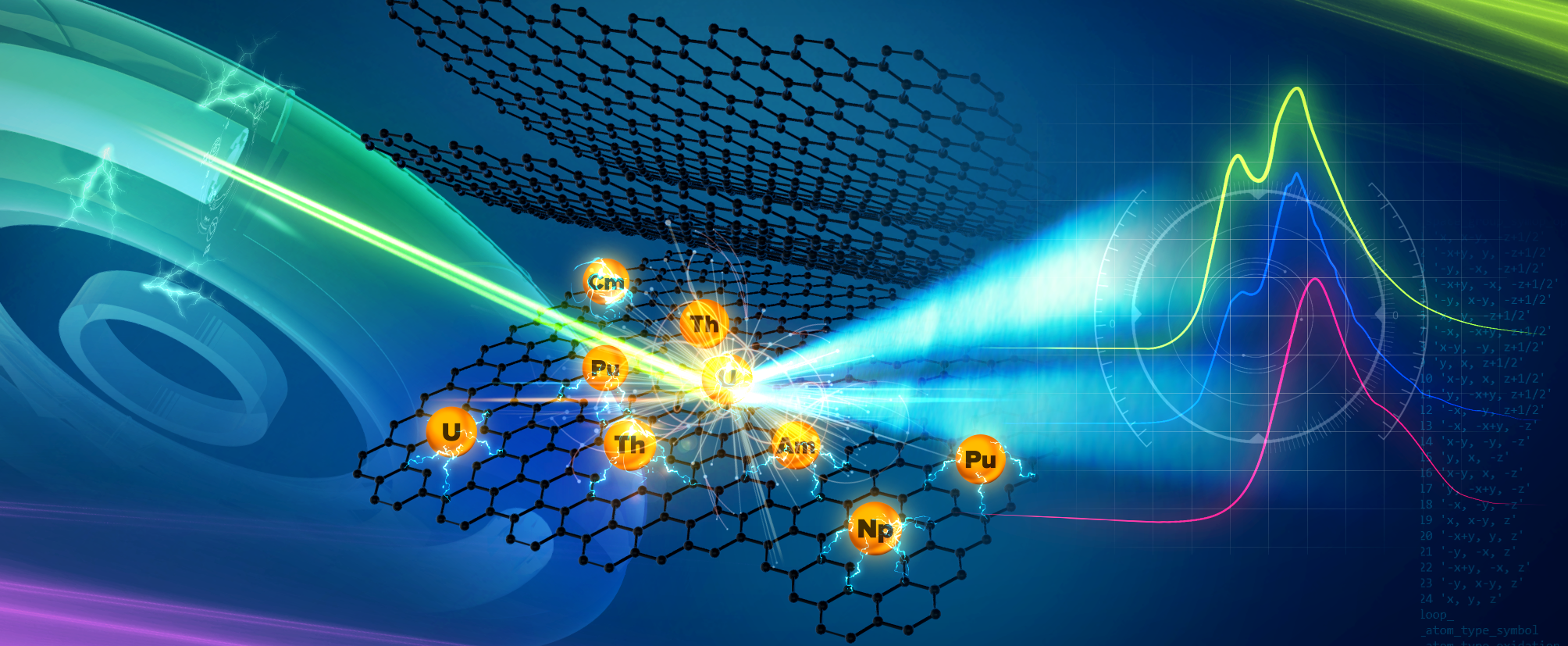
To develop an innovative approach leading to technology for the selective recovery of rare-earth metals from nuclear waste. It involves exploiting materials assembled from 2D sheets into 3D structures to improve the efficiency and selectivity of the recovery process of lanthanides from spent nuclear fuel. Traditionally, lanthanide recovery has been a challenging and resource-intensive process. 3D materials based on 2D sheets and 3D porous architectures offer increased surface areas and unique chemical properties that can facilitate the separation and recovery of lanthanides from nuclear and other industrial wastes. Utilizing specialized infrastructure for radiochemistry available at the HZDR Alpha-Lab in Germany, the Marcoule Institute in Separation Chemistry, the University of Montpellier, and the HZDR Rossendorf Beamline at the European Synchrotron Radiation Facility in France, dedicated to actinide science, together with the expertise provided by Umeå University in Sweden for the design of new materials, the material characterization capabilities of National University of Science and Technology Politehnica Bucharest in Romania, and knowledge of Uppsala University in Sweden in theory and modelling, the MaLaR team will be able to develop new approach for recovery of lanthanides using complementary competencies. Fundamental knowledge at the atomic and molecular levels, gained at the synchrotron by newly developed methods during the in-situ chemical sorption reaction on radionuclides combined with electronic structure calculations will be used to design new porous materials, by connecting the 2D sheets into the high surface area 3D architectures, engineered for separation of actinides and lanthanides from strongly acidic nuclear waste extracts. Our goal is to create a powerful close-to-the-market activity and provide high-impact novel technological solutions for the field of nuclear waste management.
MaLaR in numbers
Budget: 2.3 millions € / 3 years (2025 – 2028)
4 countries (Germany, France, Sweden, Romania)
6 partners: HZDR, NUSTPB, UU, UmU, ICSM/UM.
Six WPs: WP1: Development of cutting-edge experimental methodology; WP2: Electronic structure calculations and data analysis; WP3: Design of novel 2D-3D architectures; WP4: Separation of An and Ln from industrial waste and spent nuclear fuel; WP5: Incorporation of Ln in An oxides; WP6: Project Management, Coordination and Dissemination
The MaLaR project will provide educational opportunities for students and postdocs on hands-on experience, allowing them to gain practical knowledge and skills.
Our Partners
- Marcoule Institute in Separation Chemistry, University of Montpellier , France
- Centre National de la Recherche Scientifique (CNRS) , France
- Universities of Umeå, Sweden
- University of Uppsala, Sweden
- University POLITEHNICA of Bucharest, Romania

Work with us
Our mission is to create meaningful, lasting impact through everything we do. Contact us, in case of interest:
Kristina Kvashnina (HZDR, Dresden, Germany) – Main Coordinator, kristina.kvashnina@esrf.fr
Nicolas Clavier (CNRS, France), nicolas.clavier@cea.fr
Nicolas Dacheux (University of Montpellier, France), nicolas.dacheux@umontpellier.fr
Alexandr Talyzin (Umea University, Sweden), alexandr.talyzin@umu.se
Marius Enachescu (Center for Surface Science and Nanotechnology National University of Science and Technology POLITEHNICA Bucharest, Romania), marius.enachescu@cssnt-upb.ro
Sergei Butorin (Uppsala University, Sweden), sergei.butorin@physics.uu.se
Views and opinions expressed are however those of the authors only and do not necessarily reflect those of the European Union or EURATOM. Neither the European Union nor the granting authority can be held responsible for them.

 kristina-kvashnina.com